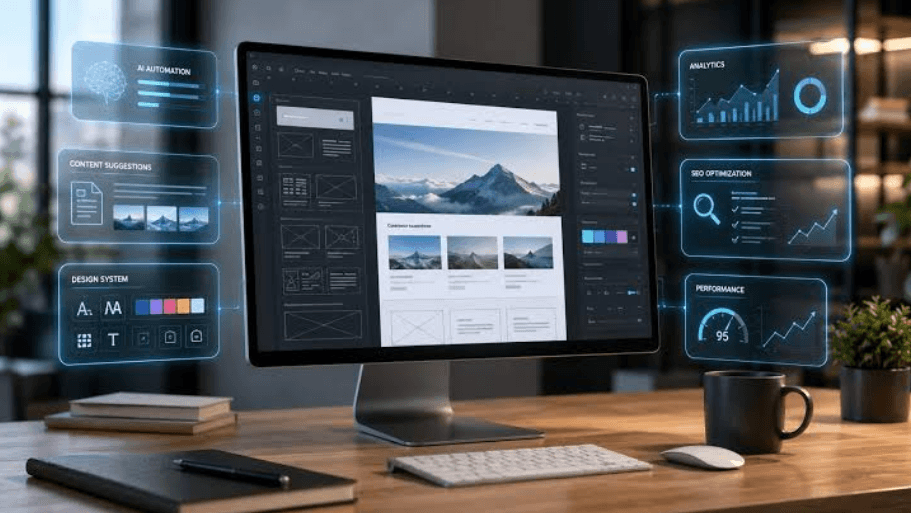
AI has changed the web design game. There’s no denying it.
You can ask an AI tool to suggest a colour palette, write website copy, generate an image, create a page layout, or even produce chunks of code. What once took hours can sometimes be done in minutes.
But here’s where things get interesting.
A website isn’t simply a collection of colours, code, images, and words. Behind every good website is a long list of decisions. Who is the website really for? What does the visitor need? What should they see first? What might make them hesitate? How can the business build trust? Which message feels genuine? What should happen when someone clicks that button?
Those questions aren’t always solved by pressing a button and letting AI do its thing.
That’s why website design in Melbourne still needs something AI can’t provide on its own: human judgement.
AI can be a fantastic assistant. It can speed things up, spark ideas, automate repetitive tasks, and help designers work more efficiently. But professional web design involves much more than producing assets.
AI Can Generate Ideas, But Humans Understand Context
Ask AI for ten homepage ideas and you’ll probably get ten ideas in seconds.
That’s useful.
But are those ideas right for your business?
That’s a different question.
A law firm, a childcare centre, a construction company, a restaurant, and a creative agency might all need websites. Yet their audiences, expectations, buying decisions, and communication styles can be worlds apart.
A generic AI-generated layout might look perfectly fine for all five.
But “fine” isn’t necessarily good enough.
A professional designer considers the context behind the business.
Who are the customers?
What are they worried about?
What motivates them?
What makes them trust a company?
What might put them off?
AI can process information and suggest patterns. But a designer still needs to decide what makes sense in the real world.
It’s the difference between having a toolbox and knowing which tool to pick.
Human Designers Understand Emotion
Let’s talk about something websites need plenty of: emotion.
People don’t make every decision with a spreadsheet.
- They hesitate.
- They compare.
- They worry.
- They get excited.
- They become curious.
- They lose interest.
- They change their minds.
A good website understands these little human moments.
Imagine someone looking for a service after having a bad experience with another provider. They’re probably looking for reassurance.
Another visitor might be in a hurry and want an answer immediately.
Someone else may be comparing several businesses and looking for a reason to choose one over another.
The website needs to speak to those situations.
That’s where human empathy comes in.
AI can identify common patterns in language. But understanding the emotional nuances of a particular audience and translating them into a genuinely appropriate experience is still a deeply human skill.
AI Doesn’t Know Your Brand Like You Do
You can give an AI a brand guide.
You can explain your tone.
You can provide examples.
You can list your values.
And AI can certainly help maintain consistency.
But a brand is more than a set of instructions.
It’s personality.
It’s history.
It’s reputation.
It’s the way a business talks to customers when something goes wrong.
It’s the little details that make a company feel like itself rather than another faceless organisation.
A professional designer can spend time understanding those subtleties.
They can ask questions.
Listen to how the business owner talks.
Look at existing marketing materials.
Understand the audience.
Then translate all of that into the design.
That’s not just filling in a template.
It’s storytelling.
Good Design Involves Knowing What to Leave Out
This one is easy to underestimate.
AI can give you more.
- More ideas.
- More headlines.
- More sections.
- More features.
- More options.
More content.
But good design often comes down to knowing what not to include.
A website doesn’t need every possible feature simply because technology makes it possible.
It doesn’t need six pop-ups.
It doesn’t need a huge animation on every section.
It doesn’t need twenty navigation options.
It doesn’t need paragraphs explaining everything under the sun.
Sometimes the smartest design decision is to remove something.
A professional designer can look at a website and say, “You don’t need this.”
That’s valuable.
Because when it comes to websites, less can sometimes be more.
Real User Behaviour Can Surprise You
You can plan a website carefully.
You can research your audience.
You can use AI to analyse trends.
You can create what seems like the perfect layout.
Then you launch it.
And visitors do something completely unexpected.
They ignore the main button.
They click something you thought was unimportant.
They leave a particular page.
They repeatedly search for information that’s already there.
They get stuck somewhere.
This is where professional web design becomes an ongoing process.
Designers can use analytics, heatmaps, user testing, feedback, and conversion data to understand what people actually do.
Then they can adjust the website.
AI can help analyse some of that information, of course.
But someone still needs to interpret the findings in the context of the business.
Numbers tell you what happened.
Experience often helps explain why.
Designers Consider the Bigger Picture
A website doesn’t live on an island.
It sits inside a broader business ecosystem.
There’s SEO.
Advertising.
Social media.
Email marketing.
Sales.
Customer service.
Branding.
Content.
Offline experiences.
A website needs to work with all of them.
For example, an advertising campaign might promise one thing while the landing page communicates something completely different.
That’s a problem.
A professional designer or digital team can spot those inconsistencies and think about the customer journey as a whole.
This is one reason website design in Melbourne should be viewed as more than simply making individual pages look attractive.
The website needs to fit into the bigger picture.
See also: SAST Explained: How Static Application Security Testing Improves Software Security
Professional Experience Still Counts
Experience matters because websites are full of trade-offs.
You want a beautiful design, but it needs to load quickly.
You want lots of information, but you don’t want clutter.
You want creative navigation, but visitors still need to find things easily.
You want animations, but they shouldn’t distract people.
You want personality, but the brand still needs to look professional.
There isn’t always a perfect answer.
Someone with experience knows how to weigh those competing priorities.
That’s one of the biggest advantages of working with a professional website design in Melbourne team.
You’re not simply paying someone to make things look nice.
You’re paying for judgement.
Wrapping It Up
AI can generate a website remarkably quickly. But generating a website and designing a genuinely effective website are two very different things.
A strong website needs more than attractive layouts and well-written text. It needs empathy, context, strategy, creativity, restraint, collaboration, and a deep understanding of the people who will actually use it.
Those are the things AI still struggles to replace.
For businesses considering website design in Melbourne, the goal shouldn’t be to avoid AI. It should be to use it wisely while keeping human expertise firmly in the driver’s seat. For more help, you should definitely talk to the experts at Make My Website.