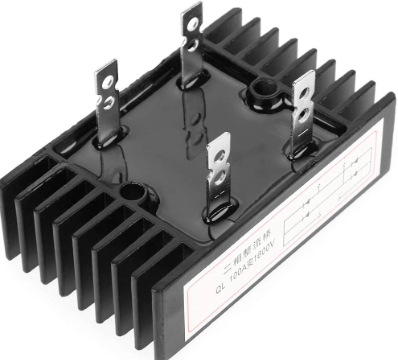
A bridge rectifier is a semiconductor component that converts alternating current (AC) into direct current (DC) by using a configuration of diodes arranged to allow current flow in one direction regardless of the input’s polarity. Bridge rectifiers are a foundational component in industrial power systems, power supplies, and renewable energy equipment, wherever AC input needs to be converted into usable DC output.
This guide explains how bridge rectifiers work, why they’re essential in industrial power systems, and what factors matter when selecting one for a specific application.
What Is a Bridge Rectifier?
A bridge rectifier uses four diodes arranged in a specific bridge configuration to convert AC power into DC power. As AC current alternates direction, the diode bridge ensures that current flows in a consistent direction at the output, regardless of which direction the input is currently cycling. This full-wave rectification process is more efficient than simpler half-wave rectifier designs, since it makes use of both halves of the AC waveform rather than discarding half of the input signal.
This function makes bridge rectifiers essential wherever equipment designed for DC operation needs to run on AC power input — which describes a significant portion of industrial and consumer electronic systems.
See also: Multifocal vs. Bifocal Reading Glasses: Which One Fits Your Lifestyle?
Why Bridge Rectifiers Matter in Industrial Power Systems
Most industrial facilities receive AC power from the grid, but a large share of internal equipment — including control systems, drives, and power supplies — operates on DC power internally. Bridge rectifiers form the conversion point between these two systems, making them a critical, if often overlooked, component in industrial power infrastructure.
Reliability matters significantly here. A failing or poorly specified rectifier can cause voltage irregularities, reduced efficiency, or complete system failure, particularly in continuous-operation industrial environments where downtime carries real operational cost.
Key Applications of Bridge Rectifiers
Bridge rectifiers appear across a wide range of industrial and energy applications, including:
- Power supplies – converting incoming AC power to stable DC output for electronic equipment
- Industrial control systems – supplying DC power to control circuits and automation equipment
- Renewable energy systems – supporting power conversion processes in solar and other renewable energy infrastructure
- Motor drive systems – often working alongside other switching components to manage power delivery in variable-speed motor applications
Because these applications vary significantly in voltage and current requirements, selecting the right rectifier specification for each use case is essential rather than treating all bridge rectifiers as interchangeable.
What to Consider When Selecting a Bridge Rectifier
Voltage and current ratings. The rectifier must be rated to handle the maximum voltage and current expected in the application, with appropriate safety margin to account for load variability and transient conditions.
Thermal performance. Industrial environments often involve higher ambient temperatures and continuous operation, making thermal tolerance and heat dissipation capability an important selection factor.
Packaging and mounting requirements. Physical form factor needs to match the equipment design, particularly in space-constrained industrial enclosures.
Efficiency and forward voltage drop. Lower forward voltage drop translates to better overall efficiency, which matters more in high-current applications where even small inefficiencies compound significantly over continuous operation.
For buyers evaluating specific options, reviewing available Goodark bridge rectifiers provides insight into how these components are typically categorized by voltage and current specification, helping narrow down suitable options based on defined application requirements.
Bridge Rectifiers vs. Other Power Semiconductor Components
It’s worth distinguishing bridge rectifiers from other common power semiconductor components, since they’re often discussed alongside components that serve different functions. While rectifiers handle AC-to-DC conversion, components like IGBTs serve a different but complementary role: managing high-efficiency power switching in applications such as motor control and inverters.
In many industrial power systems, both component types work together — a bridge rectifier converts incoming AC to DC, while Goodark IGBT products handle the subsequent switching required to regulate and deliver that power efficiently to motors, drives, or other equipment. Understanding this relationship helps clarify why a complete industrial power system typically requires multiple semiconductor component types working in coordination, rather than relying on a single component category alone.
Common Signs of Rectifier-Related Issues
While not a substitute for proper diagnostic procedures, a few patterns often indicate rectifier-related problems in industrial equipment: inconsistent DC output voltage, unexpected equipment shutdowns under load, or unusual heat generation at the rectifier component itself. These symptoms warrant inspection of rectifier specifications and condition, particularly in systems that have been in continuous operation for extended periods.
Final Thoughts
Bridge rectifiers play a foundational role in industrial power systems by converting AC input into usable DC output — a function required across power supplies, control systems, and renewable energy equipment. Selecting the right rectifier involves matching voltage, current, thermal, and packaging requirements to the specific application, often alongside complementary components like IGBTs that handle downstream power switching. Understanding both the function and the broader system context helps engineers and procurement teams make more informed sourcing decisions.
FAQs
What does a bridge rectifier do? A bridge rectifier converts alternating current (AC) into direct current (DC) using a diode bridge configuration, enabling equipment designed for DC operation to run on AC power input.
Why are bridge rectifiers important in industrial power systems? They form the conversion point between grid-supplied AC power and the DC power required by many industrial control systems, drives, and power supplies, making them essential for reliable equipment operation.
What factors should I consider when selecting a bridge rectifier? Key factors include voltage and current ratings, thermal performance, packaging requirements, and forward voltage drop, all of which should match the specific application’s operating conditions.
How are bridge rectifiers different from IGBTs? Bridge rectifiers convert AC to DC power, while IGBTs handle high-efficiency power switching for applications like motor control and inverters. Both often work together within the same industrial power system.
What are signs that a bridge rectifier may be failing? Common indicators include inconsistent DC output voltage, unexpected shutdowns under load, and excessive heat generation at the component, which typically warrant further inspection.